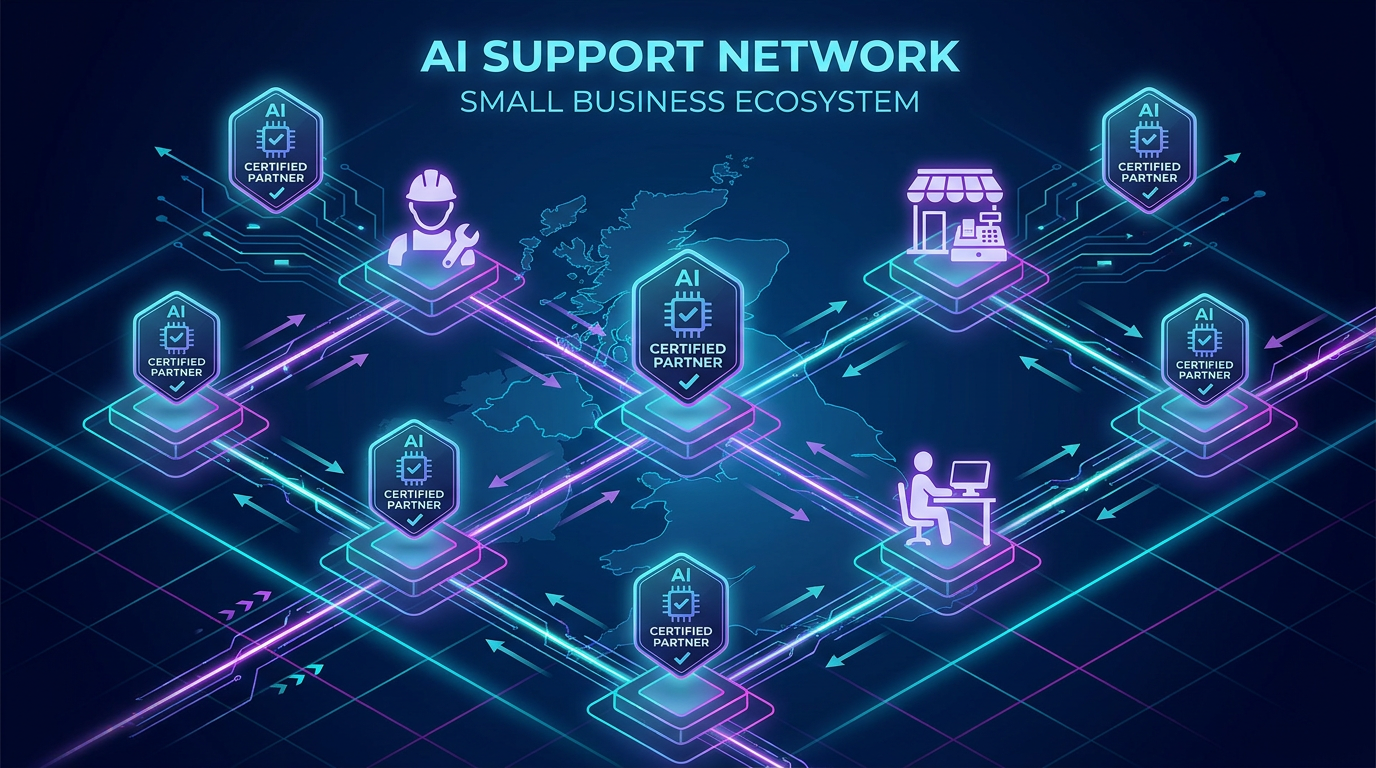
The short version: AI shifted this week from "interesting tools to try" to "a system you can build around." Certified partners, production-ready agents, government infrastructure, and cybersecurity tooling are all arriving at once.
For a small business owner, most AI news lands as a blur of product announcements, benchmark comparisons, and breathless coverage of things that won't affect you this month. This week felt different.
Four separate developments, from four different sources, all pointed at the same shift: AI is no longer just something to try. It is something you can now build operational infrastructure around — with qualified help, production-ready tools, government support, and basic security considerations that apply to businesses of your size.
What changed this week
Anthropic announced a Services Track and Partner Hub inside its Claude Partner Network. That is not a small tweak to their website. It means that for the first time, a UK business owner can search a searchable directory of certified consultants and firms who have been trained and assessed against Anthropic's standards. Three tiers: Select, Preferred, and Global Premier. More than 10,000 certified consultants. $100M in programme backing. The point is not the numbers — it is that qualified AI implementation help is now findable rather than guessable.
Microsoft Build 2026 closed with Hosted Agents in Azure Foundry confirmed for general availability by end of June. Windows itself was positioned as an agent execution platform. Six new MAI language models were released. If your business runs on Windows and Microsoft 365 — email, calendar, Teams, Word, Excel — autonomous AI agents that read service enquiries, update CRM records, and schedule tasks are now production-ready. Not beta. Not experimental. Available.
The UK Department for Science, Innovation and Technology confirmed a £722.9M capital budget increase for AI, data centres, and connectivity. Alongside the money, DSIT announced AI Growth Zones — designated areas where eligible businesses can test AI applications with temporary regulatory flexibility before full compliance rules apply. For any operator who has been hesitant because of GDPR or sector-specific regulation, this is the legal route to proving AI value first.
Anthropic expanded Project Glasswing, a restricted programme giving organisations access to Claude Mythos — a purpose-built model for cybersecurity and infrastructure defence. One hundred and fifty-plus organisations across fifteen countries now have access. Early participants identified more than 10,000 security vulnerabilities. This is still beyond most small businesses directly, but the direction is clear: AI-grade security scanning is moving outward from the largest enterprises.
Why a support structure matters for small businesses
The pattern across these four stories matters more than any single announcement. Most small businesses that struggle with AI adoption do not fail because the model is not capable enough. They fail because there is no structure around it — no identified owner, no defined workflow, no approved data sources, no way to measure whether anything improved.
Someone signs up for a tool. Someone else tries a different one. Staff paste customer data into whichever service is fastest that week. A few impressive demos happen. Then the enthusiasm fades because nothing was connected to a repeated business process with a clear owner and a measurable output.
What has been missing, for small businesses specifically, is the scaffolding: certified people to help build it properly, production-ready platforms that won't require rebuilding in six months, government support that removes the regulatory excuse, and a growing security layer that means customer data can be handled responsibly rather than anxiously.
That scaffolding is now arriving. It does not mean AI is easy or that adoption is guaranteed. It means the structural barriers — "I don't know who to trust," "I'm not sure it's stable enough," "I don't know if it's legal," "I don't know if it's safe" — are being systematically addressed.
The mistake to avoid this week
Chasing the announcements. The certified partner list, the agent toolkit, the growth zone programme, the cybersecurity model — none of these will improve your business if you have not defined the workflow problem first.
The support structure helps you execute. But you still need a starting point. And the starting point is not a tool decision. It is a workflow decision: which process in this business is painful, repetitive, and currently costing more time or money than it should?
Until you have answered that question clearly, every new tool announcement is noise. Once you have answered it, the partner hub, the agent toolkit, and the growth zone programme all become relevant entry points rather than abstract developments.
What AIFA would do with this signal
Map the workflow first. Find the painful repetitive process. Define what AI-assisted looks like — not AI-replaced, but AI-assisted. Note the trigger, the manual steps, the tool it currently lives in, and what a better outcome would look like.
Then pick the right partner or tool to help build it. The Anthropic partner hub and Microsoft's agent toolkit are both valid entry points — but only if you have a clear destination. A good certified partner will ask you the workflow question before recommending a tool. That is the signal that they are worth working with.
The practical questions to start with:
- Which process in this business currently costs more than three hours per week?
- Where do leads or customer requests get delayed, forgotten, or mishandled?
- Which tool already holds the data for that process — CRM, inbox, calendar, spreadsheet?
- What would "better" look like, and how would we know it had improved?
- What must never be automated without human sign-off?
From those answers, a useful first automation becomes obvious. It is usually not the most ambitious idea. It is usually the most obvious friction point, handled more reliably than it is today.
Operator move for this week
Write down one workflow that currently costs you more than three hours per week. Note the trigger, the manual steps, the tool it lives in (CRM, inbox, calendar, spreadsheet), and what "better" would look like. That brief is worth more than any AI tool decision — and it is exactly what a good certified partner will ask you for first.
Bottom line
This week's AI news is not about bigger models or flashier demos. The useful signal is that the structure around AI — qualified help, stable platforms, government support, and basic security tooling — is becoming real for businesses below enterprise scale.
Small businesses do not need to replicate an enterprise AI strategy. They need a practical workflow: clear starting point, qualified assistance, sensible data handling, and a simple way to measure whether anything improved.
That was hard to do reliably six months ago. It is considerably less hard this week.