The short version: Microsoft has moved AI agents from experimental to production-ready. If your business runs on Windows and Microsoft 365, autonomous workflow automation is available now — not in a future roadmap.
What Microsoft announced at Build
Three announcements define the close of Microsoft Build 2026. First, Hosted Agents in Azure AI Foundry will reach general availability by the end of June. These are autonomous agents that can be deployed to handle defined workflows — reading data, taking action, updating records — without manual triggering for each task. The move from preview to general availability means they are considered stable enough for production business use.
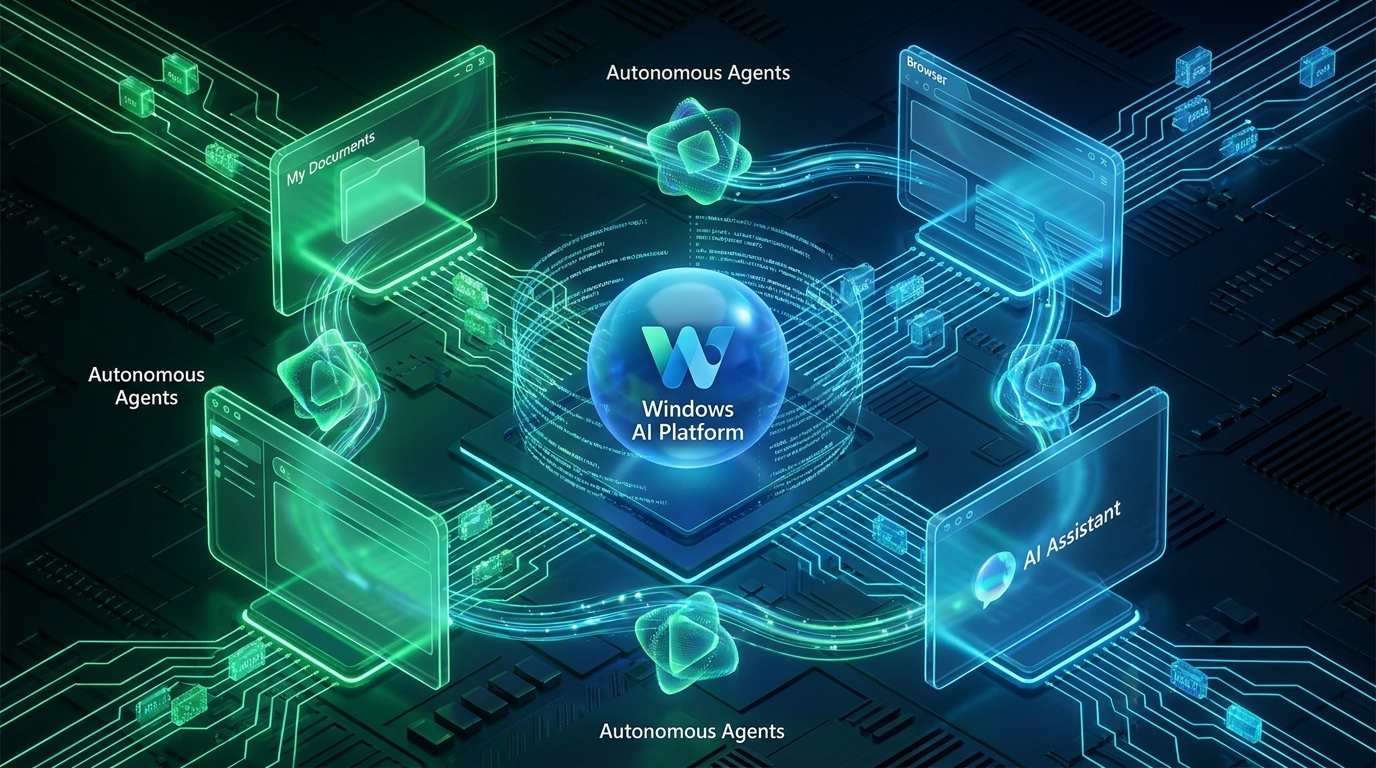
Second, Microsoft repositioned Windows itself as an AI agent execution platform. This is not a cosmetic rebrand. It means the Windows operating system is being structured to run local agents natively — agents that can act on your machine, access your files and applications, and carry out tasks across the Microsoft 365 suite without everything being routed through a cloud service.
Third, Microsoft released six new MAI language models. These are purpose-built models designed to run efficiently within the Microsoft stack — Azure, Windows, Office — rather than general-purpose models used across all contexts. The practical effect is that AI tasks within Microsoft products can use models specifically tuned for business document, communication, and productivity workflows.
What this means for Windows-based small businesses
If your business runs on Windows and Microsoft 365 — email in Outlook, documents in Word, data in Excel, meetings in Teams, contacts in a Microsoft-integrated CRM — the infrastructure for autonomous AI agents is now production-ready rather than experimental.
The practical starting point for most small businesses is not a complex multi-step agent. It is a single defined workflow that currently requires manual reading, manual decision, and manual action. A service enquiry arriving by email: read the message, extract the key details (name, service requested, postcode, urgency), create a CRM record, and flag for follow-up. That kind of task can now run as a production-ready agent rather than a manual step that relies on someone remembering to do it.
The key shift from Build is that "production-ready" carries a different weight than "interesting to try." Microsoft's general availability signal means businesses can now invest in building and refining these agent workflows with a reasonable expectation that the platform will not change underneath them in three months.
Operator move for this week
If your business runs on Windows and Microsoft 365, ask your IT support or an AIFA-style consultant this week to scope one agent workflow: reading your service enquiry emails, extracting key details, and creating a CRM record. That is a reasonable starting point for your first production-ready AI agent.