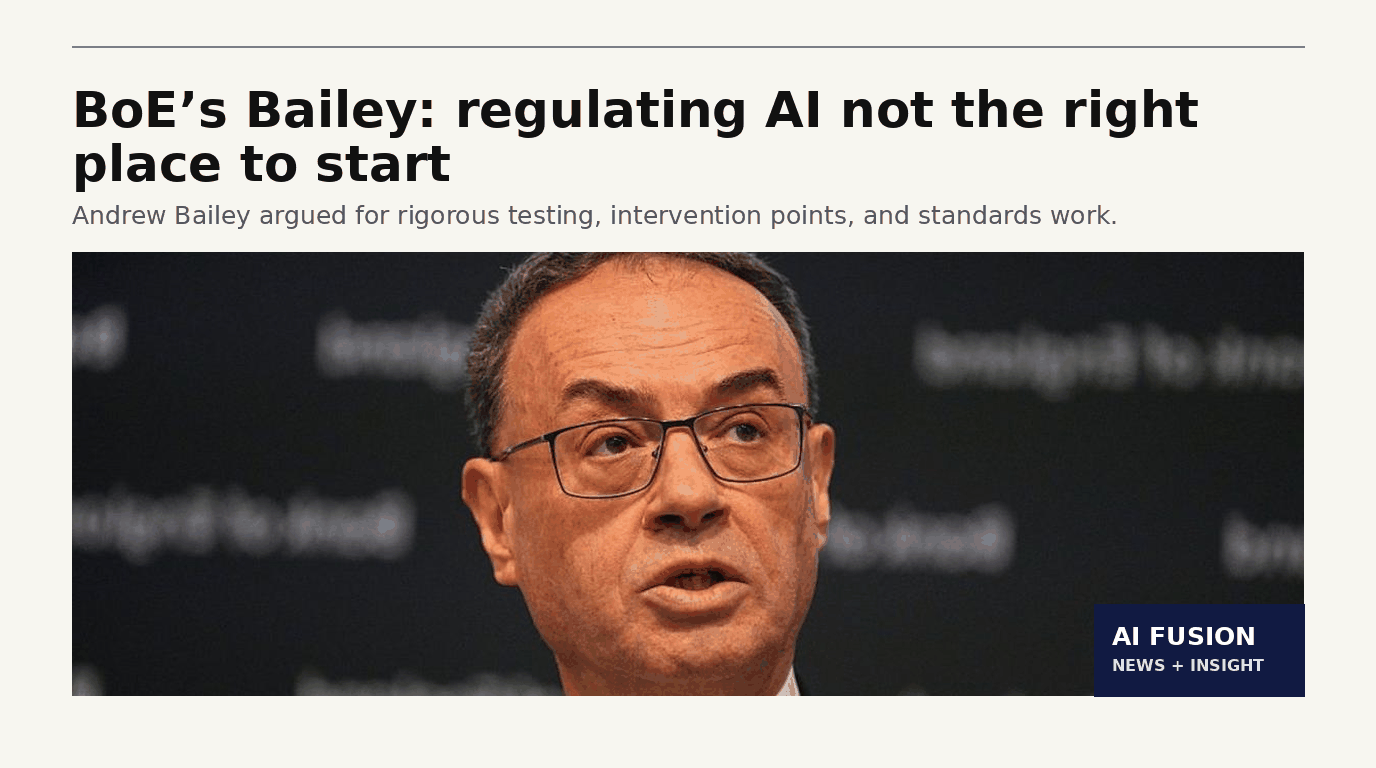
Frontier access is narrowing while oversight stacks. Andrew Bailey argued for rigorous testing, intervention points, and standards work — including via the UK AI Security Institute — before rushing to new AI regulation. He said benefits are immense, risks are real, and unexpected model behaviour in tests is why testing is necessary.
What Bailey argued
In his first article for Substack, covered by the BBC on 30 September, Bank of England Governor Andrew Bailey said regulating artificial intelligence “is not the right place to start.” He called first for rigorous testing to find vulnerabilities and create safeguards that can contain risk. The risks around AI were “real and increasingly significant,” he wrote, while arguing that development should not be halted or prohibited — “on the contrary, the benefits are immense.” There must, however, be a system for intervention and for establishing the boundaries in which AI operates.
Bailey said important work is already under way in the UK, including through the AI Security Institute, and that this testing should help form part of a set of standards. “But the pace of progress must accelerate,” he added, “we should proceed with a degree of humility.” With testing there will be failures, and “models will behave unexpectedly.” That, he said, “is not evidence that testing has failed, rather it is evidence of why testing is necessary.”
Testing first, regulation later
Bailey was explicit that testing should not be treated as an alternative to future regulation. Over time a more formal regulatory framework might emerge. “But regulation is not, in my view, the right place to start.” He highlighted frontier AI — highly advanced, self-learning systems which, without an effective way to intervene, risk becoming “a closed loop in which the model progressively governs itself.” The BBC placed the essay against a week in which lab chiefs had called for slower development and a White House meeting produced a voluntary, “morally binding” industry document.
Coverage context
A UK testing-first stance now sits beside US consumer and state enforcement and a gated Gemini launch. Oversight is stacking, but not every capital wants a statute as the first move.
Read the full daily brief hub: www.aifusionautomations.com/news/